
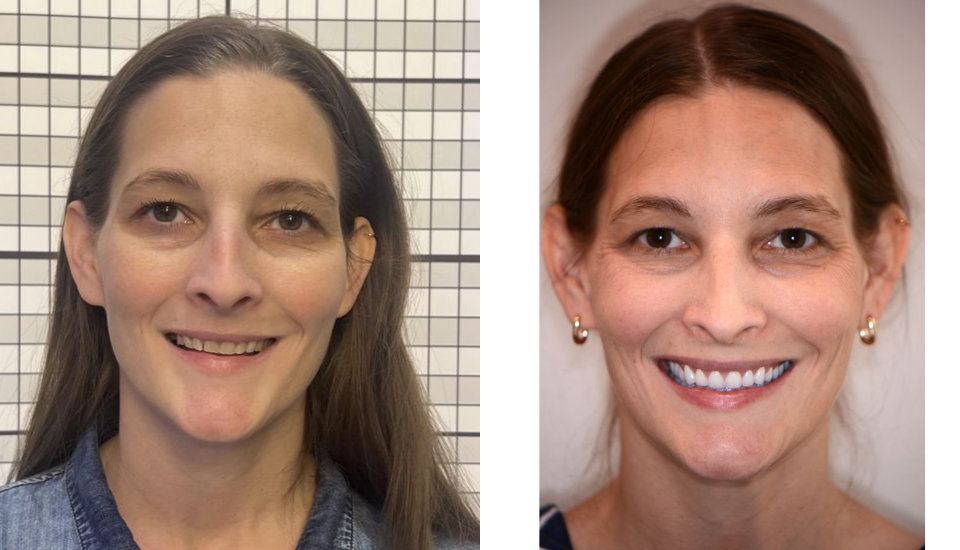
 BeforeAfter
Sleep apnea is a breathing problem during sleep: the airway narrows or closes, and breathing stops for seconds at a time. We offer non-surgical airway dentistry for adults and children at either of our Frisco offices, including custom oral appliances for people who cannot use CPAP. A sleep physician diagnoses sleep apnea. We build the dental treatment around your sleep study and a 3D scan of your airway.
Many airway plans include Vivos expansion for suitable patients.
Written by Millennium Smiles. Medically reviewed by Dr. Dunia Korous, D.D.S., General Dentist. Last updated October 31, 2026.
Credentials: FICOI (Fellow of the International Congress of Oral Implantologists) and MICOI (Master of the International Congress of Oral Implantologists).
Dr K brought hope for a permanent solution to my sleep apnea that I literally was in tears of hope to hear and start treatment on.

Dr. Korous’s airway training
Dr. Dunia Korous is Vivos-trained and focused on airway health. She has completed over 1,000 hours of advanced education, including 3D CBCT airway evaluation, oral appliance therapy, myofunctional therapy, Myobrace training for children’s airway development, and tongue-tie and lip-tie evaluation and release, studied with airway surgeon Dr. Soroush Zaghi, MD. Airway care sits between dentistry, breathing and sleep, so she looks at the teeth, the jaw, the tongue and the airway together.
About Our PracticeRead Our Free Sleep Apnea eBook
Our free Sleep Apnea eBook covers the signs, the risks of leaving it untreated, and CPAP alternatives worth knowing about.
What a dentist can see
Sleep apnea often shows up in the dental chair before a patient connects it to sleep. These are the clues we check at your exam:
- A scalloped tongue, with tooth marks along the edges
- Teeth worn flat from grinding at night
- A narrow upper jaw or a high, arched palate
- A small lower jaw that sits back
- Enlarged tonsils or a crowded throat
None of these proves sleep apnea. Together with your sleep study, they show where the airway is narrow and which treatment fits.


What happens at your first visit
- We review your sleep study, symptoms and medical history.
- We examine your teeth, jaw joints, tongue and airway.
- We take a 3D CBCT scan to measure the airway and the upper jaw.
- We explain your options and give you a written estimate.
- We start treatment and schedule follow-ups with your sleep physician.
Your treatment options
| Option | Who it suits | What it does |
|---|---|---|
| Custom oral appliance | Mild to moderate sleep apnea, snoring, or CPAP intolerance | Holds the lower jaw slightly forward so the airway stays open |
| Palatal and jaw expansion (Vivos) | Adults and children with a narrow upper jaw | Widens the upper jaw to open the nasal airway and give the tongue room |
| Myofunctional therapy | Adults and children with mouth breathing or low tongue posture | Exercises that retrain the tongue, lip and throat muscles |
| Tongue-tie and lip-tie release | Patients with restricted tongue or lip movement | Frees the tongue so it rests and moves correctly |
| Solea laser therapy | Adults whose soft palate sags and narrows the airway | Tightens and lifts the soft palate |
| Orthodontic support | Patients whose jaw alignment limits the airway | Aligns the teeth and jaws to support the other treatments |
What is palatal expansion therapy for sleep apnea in adults?
Expansion is not only for children. In adults, a narrow upper jaw can crowd the tongue and limit nasal breathing. Skeletal expansion with a Vivos device widens the upper jaw gradually, which can open the nasal airway and give the tongue more room. It takes longer than an oral appliance, so we reserve it for adults whose 3D scan shows a narrow jaw and who want to treat the cause, not only the symptom.
Vivos expansion is one of the ways we widen a narrow upper jaw in adults and children.
Airway care for children
Children can have airway problems too, and early care can guide jaw growth. These signs are worth a visit:
- Snoring or noisy breathing at night
- Mouth breathing during the day
- Restless sleep or grinding teeth
- Trouble focusing at school
- A narrow palate or crowded teeth
Care for children uses Myobrace training, myofunctional therapy and gentle expansion. We also check for tongue-tie and lip-tie. Your child’s doctor stays involved throughout.
CPAP, oral appliances and the guidelines
CPAP is usually the first choice for severe sleep apnea. For adults who cannot tolerate CPAP, or who prefer another option, the 2015 guideline from the American Academy of Sleep Medicine and the American Academy of Dental Sleep Medicine recommends a custom oral appliance made by a trained dentist. We work with your sleep physician, who confirms the diagnosis and checks that the appliance is working.
Questions patients ask about sleep apnea treatment
What are my options for sleep apnea if I can’t use CPAP?
The main dental option is a custom oral appliance that holds the lower jaw forward and keeps the airway open while you sleep. Other options address the cause: palatal expansion widens a narrow upper jaw, and myofunctional therapy retrains the tongue and throat muscles. Which one fits depends on your sleep study and a 3D scan of your airway. We build the plan with your sleep physician.
Should I choose CPAP or a dental appliance for sleep apnea?
For severe sleep apnea, CPAP is usually the first choice. For mild to moderate sleep apnea, or when you cannot wear CPAP, a custom oral appliance is a recognized option. The appliance is quiet, small and easy to travel with. Your sleep physician confirms the diagnosis and checks the result. If you stopped using CPAP because of the mask or the noise, tell us. We can look at the airway and show you what else is possible.
Oral appliance therapy vs. myofunctional therapy: which is right for sleep apnea?
An oral appliance changes the position of the jaw while you wear it. Myofunctional therapy trains the muscles of the tongue, lips and throat so the airway works better during the day and at night. The two often work together. Adults with moderate sleep apnea may start with the appliance, and children usually start with therapy and expansion. We decide after the exam and the scan.
Can a dentist help with sleep-disordered breathing in children?
Yes, in partnership with the child’s doctor. A dentist can spot a narrow upper jaw, mouth breathing, a tongue-tie or crowded teeth, all linked to poor airway development. We use Myobrace training, myofunctional therapy and gentle expansion to guide growth.
What is a Mallampati score?
A Mallampati score is a rating from 1 to 4 of how much of your throat you can see when you open your mouth wide and stick out your tongue. A higher class can mean a narrower airway, so it is one part of an airway exam, along with your sleep study and a 3D scan. Read more in our Mallampati score article.
Booking, cost and what to expect
Does Millennium Smiles treat sleep-disordered breathing in kids and adults?
Yes. We treat children and adults. We use 3D CBCT scans to measure each airway. Adults start with a sleep study review and an exam. Children start with an airway and growth evaluation. Book online at either of our Frisco offices or call (469) 200-8123.
What is the myofunctional therapy and jaw expansion program at Millennium Smiles?
Our program combines three steps: a 3D CBCT scan of the airway, myofunctional therapy to retrain the tongue and lip muscles, and expansion when the upper jaw is narrow. Children also use Myobrace. Dr. Korous guides each case.
Patients come to us from Heritage Green, The Lakes on Legacy Drive, Villages of Stonebriar Park and across Frisco.
How much does myofunctional therapy cost for kids?
Our Millennium Smiles families typically see a Myobrace series on its own come in around the low thousands, with an expander package or a full myofunctional therapy program running higher, in the mid-thousands. The number depends on your child’s age, how many sessions are needed and whether expansion is part of the plan, and dental insurance rarely covers all of it. You get a written estimate before anything starts.
Does Millennium Smiles accept insurance and offer financing?
We accept all PPO dental insurance plans. Sleep apnea treatment is not billed to medical insurance. We offer financing through Cherry, CareCredit, Sunbit and Proceed Finance, and in-house financing may also be available case by case, depending on the cost of treatment.